
DENTURES
DENTURES ARE A TIME-TESTED OLD FRIEND
DENTURES IN MISSISSAUGA
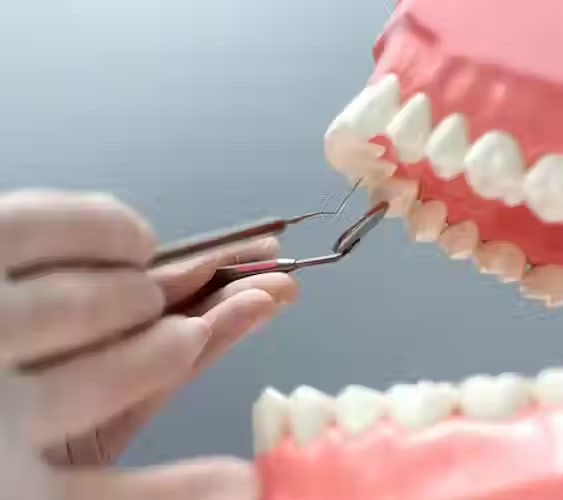
DENTURES CAN HELP REPLACE ONE OR MORE MISSING TEETH
When a tooth is lost from decay or trauma, there are multiple reasons that you may want to have it replaced. Medically speaking, every tooth in your mouth is essential to helping others stay in position and to retain the health and strength of your jawbone. Teeth also play an important role in normal speech and allow you to properly chew your food, so you gain the most nutrition from them. Beyond the practical reasons, there are also aesthetic ones. Gaps in your teeth can cause self-image issues and concerns about flashing your smile. Dunwin Dental offers dentures as a natural-looking teeth replacement solution.
DENTURES ARE A COMMON, RELIABLE WAY TO RESTORE YOUR SMILE, EATING FUNCTION AND ABILITY TO SPEAK
Dentures are a popular and effective option to replace your missing teeth. They have been in use for centuries. Almost 19% of the world’s population wears some type of denture. Almost 90% of all people who don’t have natural teeth wear a denture. Modern technology has created dentures that are more comfortable, more effective, and more natural in appearance than ever before.
Dentures offer numerous advantages such as:

TYPES OF DENTURES
You can choose from two types of dentures - complete and partial dentures depending upon your situation.

Complete Dentures
If you have lost ALL of your natural teeth, complete dentures can replace your missing teeth.
If you have any natural teeth remaining in your mouth, they will need to be removed before your conventional complete denture can be made and placed in your mouth. Healing after extractions may take several months.
You may get an immediate denture to wear during this healing period so that you do not appear in public without teeth. Immediate denture will also protect the tissue, reduce bleeding, establish your speech patterns early, help you chew better than without teeth and minimize your facial distortion due to teeth loss.
Conventional complete dentures have replacement teeth fitted into a plastic base made to closely match the color of your gums. The base of the upper denture covers the palate (the roof of your mouth) and it rests against your gums and palate. The lower denture has a horseshoe shape. It rests on the gum and bone tissues of your dental ridge. Saliva helps create a tight seal to hold the dentures in place.
Conventional complete dentures can be put in and taken out as needed.
Implant-Supported Complete Dentures
Implant-supported dentures are natural looking, more stable, comfortable and secure than conventional dentures. These dentures don't make you gag, don't cover the roof of your mouth and allow you to taste food. You can eat pretty much anything you used to eat with your natural teeth.
Unlike conventional dentures, implant-supported dentures are not removable by you. Only a dentist or an oral surgeon can remove them.
Implant-supported complete dentures are attached to dental implants. You would need to qualify for implants to be surgically placed for this to happen. Please see our Dental Implants section for more information. Like complete conventional dentures, implant-supported dentures will require all your natural teeth be removed and healing to occur before implant-supported denture can be placed. This process also takes several months.
Partial Dentures
A partial denture may be suggested as a solution when you are only missing some of your teeth.
A removable partial denture is fitted to a metal framework or plastic base that matches the colour of your gums and is designed to fit snugly around your remaining teeth. It can easily be taken out of your mouth for cleaning and storing before going to bed. Your dentist will adjust your denture so it fits comfortably and show you how to wear and remove it.
Some patients use these dentures as a permanent solution to their dental replacement needs. In other cases, these dentures are designed and worn while the patient’s oral cavity heals from other treatments. Upon completion of the healing process, the partial denture will be removed, and permanent solutions put in place.
THE DENTURE TREATMENT PROCESS AND WHAT TO EXPECT
1st Appointment
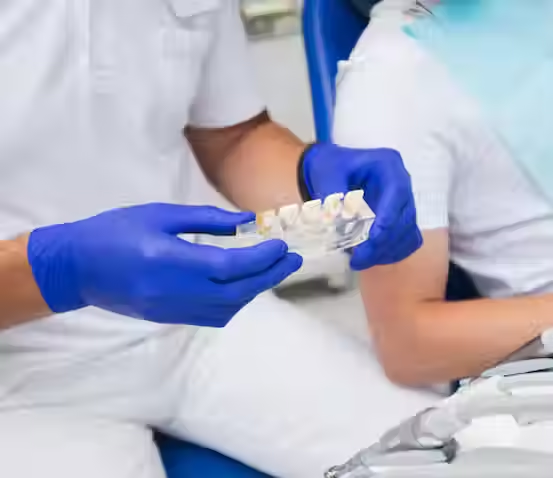
2nd Appointment
3rd Appointment (If Necessary)
Final Appointment
ARE DENTURES A GOOD OPTIONS FOR ME TO REPLACE MY MISSING TEETH?
Talk to your dentist at Dunwin Dental to check if dentures are a good option to replace your missing teeth.
GETTING USED TO YOUR DENTURES MAY TAKE SOME TIME

It takes practice to put in and take out your denture. Your denture may feel bulky, a bit odd or tight for the first few weeks. But in time, you will get used to it.
Wear your dentures most of the time. Remove your denture before you go to bed and put them back in when you wake up. Wearing your denture around the clock can cause the tissues in your mouth to become irritated.
Some soreness should be expected for the first week or two. Call Dunwin Dental if you develop a sore or irritation that does not go away. Your denture may need adjustments to make it feel more comfortable.
Do not force your denture into place by biting down or try to adjust it yourself. You can harm your mouth and damage your denture.
You will also need to practice talking with your new denture. Talk slowly to speak clearly and prevent muffled speech. Try repeating hard to speak words. If your denture slips out of place when you laugh, cough or smile, bite down and swallow to reposition it.
You can begin using dentures by eating soft foods cut into small pieces. Try chewing on both sides of your mouth to keep the pressure even. Do not chew very sticky or hard foods.
You may have to use a denture adhesive as you get used to wearing your denture. A denture that fits correctly usually does not need an adhesive because it only needs saliva to create a tight seal that holds it in place.
Clean your denture every day. Take it out of your mouth and rinse off food particles. Use a special brush made for cleaning dentures. Wet a denture brush and put denture cleaner on it. Do not use toothpaste to clean dentures.
Do not lose, drop or damage your dentures. Keep your dentures away from curious children and pets when you are not wearing them.
Brush your gums, tongue and the roof of your mouth twice each day with a soft-bristled brush before you put in your denture.
The following video explains how to get used to dentures:
DENTURE AFTERCARE
If you have lost one or more teeth, contact our dental office in Mississauga to discuss whether a partial or complete denture is a suitable tooth replacement option available to you.
